
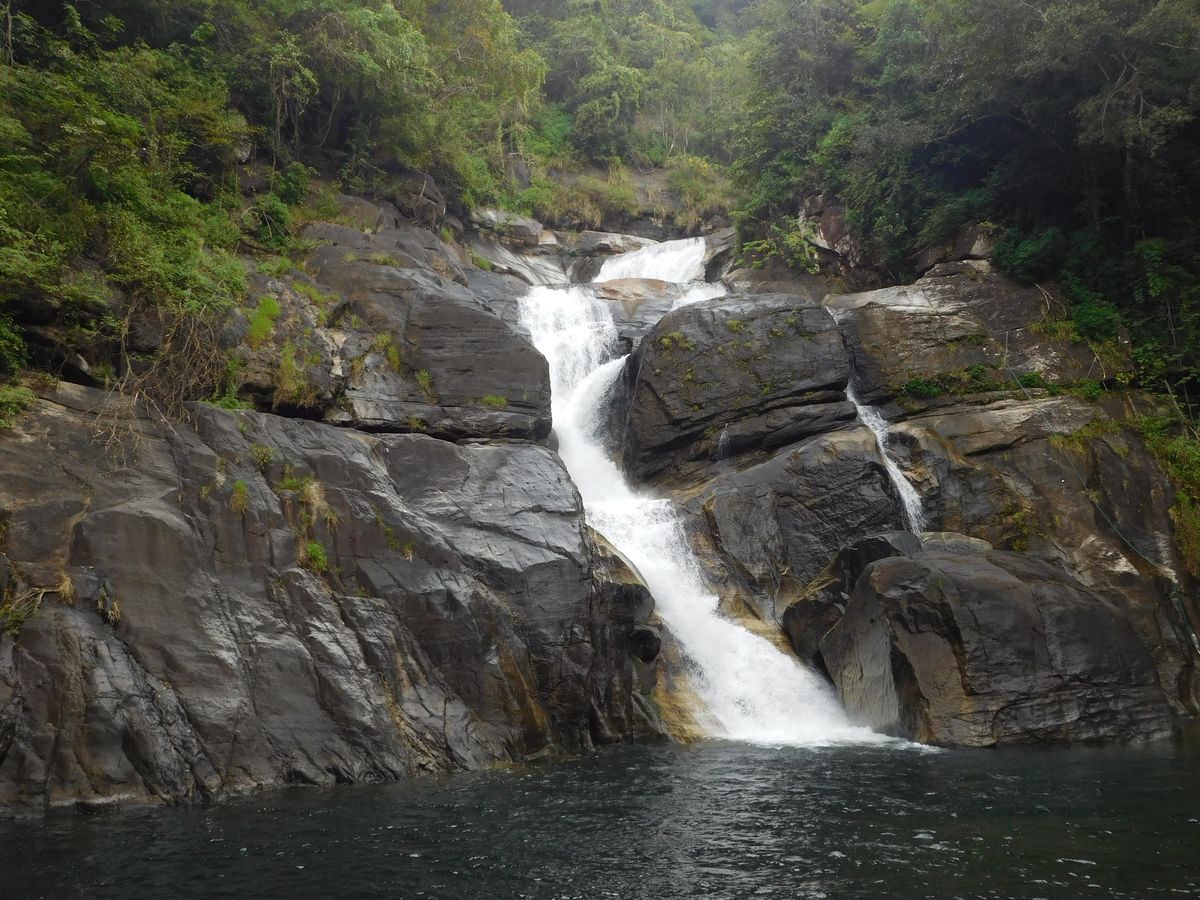
Welcome to today's daily update of Geographic details regarding waterfalls and natural formations across different regions. While there is no standard way to measure the height or width of a waterfall [List of waterfalls - Wikipedia], many numbers are estimated, and measurements may be imprecise [List of waterfalls - Wikipedia]. Across the globe, notable waterfalls are sorted by continent, then country, then province, state, or territory [List of waterfalls - Wikipedia]. A waterfall is generally included in such notable lists if it is at least 15 m (50 ft) tall, or if it is considered significant [List of waterfalls - Wikipedia].
Looking at different regions, various waterfalls hold distinct records and characteristics. For instance, in Africa, the Tugela Falls in KwaZulu-Natal, South Africa, stands at 948 m (3,110 ft) high and is recognized as the highest waterfall in Africa [List of waterfalls - Wikipedia]. Meanwhile, Mutarazi Falls in Zimbabwe reaches 762 m (2,500 ft) high, making it the highest in Zimbabwe, the second highest in Africa, and the 17th highest in the world [List of waterfalls - Wikipedia].
In Asia, notable geographical features include the Ban Gioc–Detian Falls, which is Asia's largest transnational waterfall shared between China and Vietnam in the Karst Hills of Daxin County, Chongzuo Prefecture, Guangxi Province [List of waterfalls - Wikipedia]. Another well-known Asian waterfall is Kegon Falls, located at Lake Chūzenji (the source of the Oshiri River) in Nikkō National Park near the city of Nikkō, Tochigi Prefecture, Japan [Kegon Falls - Wikipedia]. These falls were formed when the Daiya River was rerouted by lava flows [Kegon Falls - Wikipedia]. According to Wikipedia, the main falls had a height of approximately 97 metres (318 ft), and about twelve smaller waterfalls are situated behind and to the sides of Kegon Falls, leaking through the many cracks between the mountain and the lava flows [Kegon Falls - Wikipedia]. In 1927, Kegon Falls was recognized as one of the "Eight Views" which best showed Japan and its culture in the Shōwa period, and it is also listed as one of "Japan’s Top 100 Waterfalls" in a listing published by the Japanese Ministry of the Environment in 1990 [Kegon Falls - Wikipedia].
In other parts of the world, Nepal is home to several remarkable waterfalls [Top 20 Waterfalls in the Himalaya | Komoot]. The temple and waterfalls in the Annapurna Conservation Area offer impressive views within a deep gorge [Top 20 Waterfalls in the Himalaya | Komoot], while other notable cascades include Pachal Waterfall, recognized as Nepal's tallest, and Hyatung Waterfall, one of Asia's highest, both offering dramatic plunges amidst lush landscapes [Top 20 Waterfalls in the Himalaya | Komoot].
Moving to the Hawaiian islands, Oloʻupena Falls is located in the north-eastern part of the Hawaiian Island of Molokai [Oloʻupena Falls - Wikipedia]. At 2,953 feet (900 meters), it is unofficially cited as the fourth highest waterfall in the world and the highest in the United States [Oloʻupena Falls - Wikipedia]. These falls occur where a short, seasonal stream spills over the edge of one of the tallest sea-side cliffs of the world, located between the Pelekunu and Wailau valleys [Oloʻupena Falls - Wikipedia]. Additionally, in Honolulu County, the best waterfalls are found on the island of Oahu, a region characterized by its volcanic origins, lush valleys, and coastal landscapes, featuring numerous natural water formations nestled within dense forests or accessible via trails [Top 11 Waterfalls in Honolulu County | Komoot].




Social Plugin